
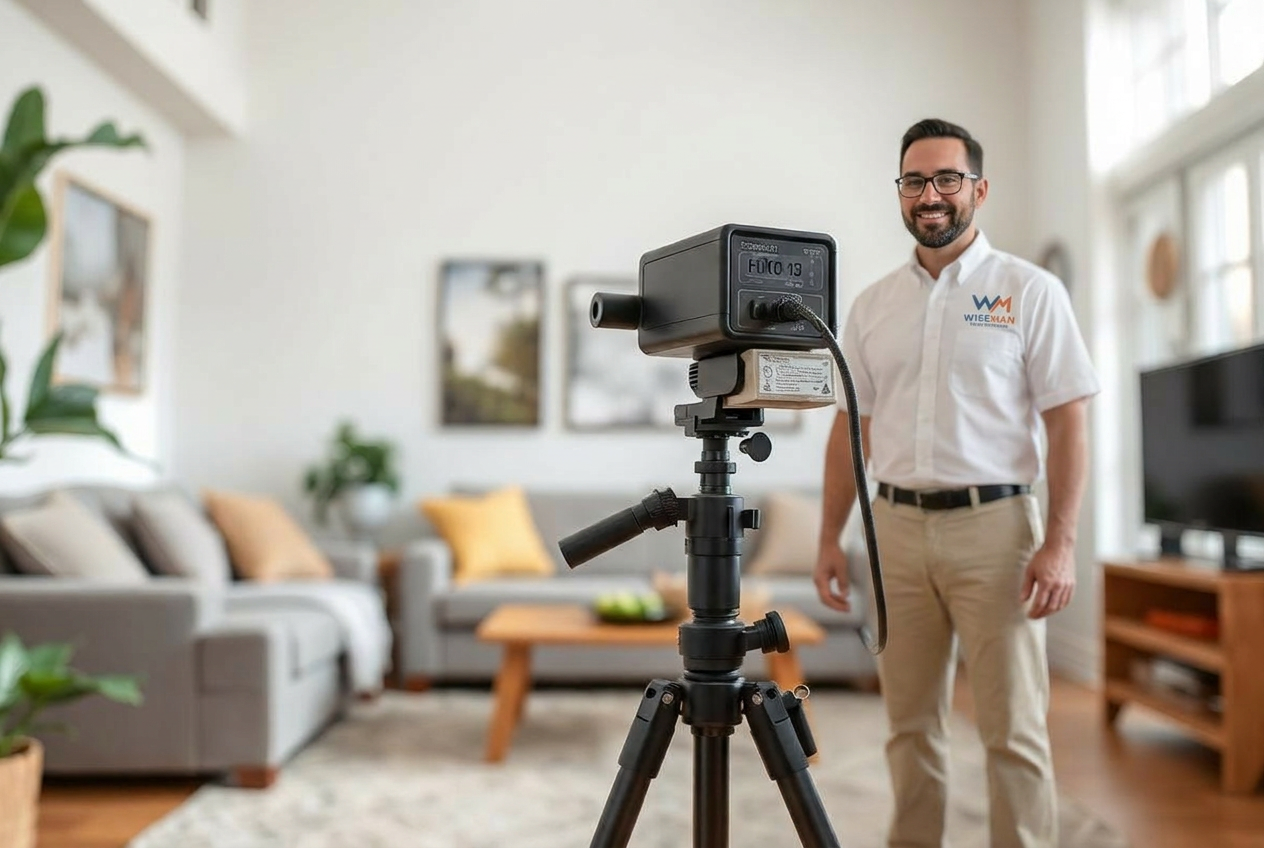
The most useful test for the air you breathe.
Air sampling is often the single most informative test in a mold investigation. By drawing a known volume of indoor air through a spore-trap cassette and then comparing the laboratory result to an outdoor control collected the same day, we can determine whether the indoor environment is meaningfully different from the surrounding outdoor air — and which mold genera are responsible for any elevation.
We apply air sampling judiciously. Not every property needs it. When it is appropriate — concealed contamination is suspected, occupants are symptomatic, post-remediation verification is required, or objective documentation is needed for insurance or real estate — air sampling delivers data you can act on.
How spore-trap air sampling works
A calibrated air pump pulls a fixed volume of air — typically 75 to 150 liters — through a sealed plastic cassette containing a sticky adhesive slide. Airborne particles, including mold spores, are deposited on the slide. The cassette is then sealed, labeled, logged on a chain-of-custody form, and shipped to an AIHA-accredited laboratory. Trained analysts identify and count spores under a microscope and report concentrations in spores per cubic meter of air, organized by genus.
Why outdoor controls are non-negotiable
San Diego's outdoor air carries a background load of mold spores that varies daily with humidity, recent weather, vegetation, and microclimate. La Jolla, Hillcrest, and Encinitas can all show very different outdoor profiles on the same day. Without a same-day outdoor control collected at the property, indoor results cannot be interpreted with any confidence. Every Wiseman Mold Inspection air sampling protocol includes at least one outdoor control.
Reading your results responsibly
A higher indoor count than outdoor is one signal worth investigating. The presence of indicator genera such as Stachybotrys, Chaetomium, or unusual concentrations of Aspergillus/Penicillium raises the priority. But isolated numbers without context — visual evidence, moisture data, occupant symptoms — can lead to both over-reaction and under-reaction. We always interpret air sampling within the full picture of the inspection.
Sample locations and quantities
A standard residential air sampling visit captures one outdoor control plus two to three indoor samples — typically one in the area of concern and one in a representative unaffected area for indoor-to-indoor comparison. Larger homes, commercial properties, and multi-unit buildings warrant additional samples based on square footage, HVAC zoning, and the scope of the concern.
Air sampling and post-remediation verification
Air sampling plays a central role in post-remediation verification. After a remediation contractor has completed work, we visit independently to perform a visual inspection, moisture verification, and a structured air sampling protocol against documented clearance criteria. The result is an objective answer to a simple question: did the remediation actually solve the problem?