
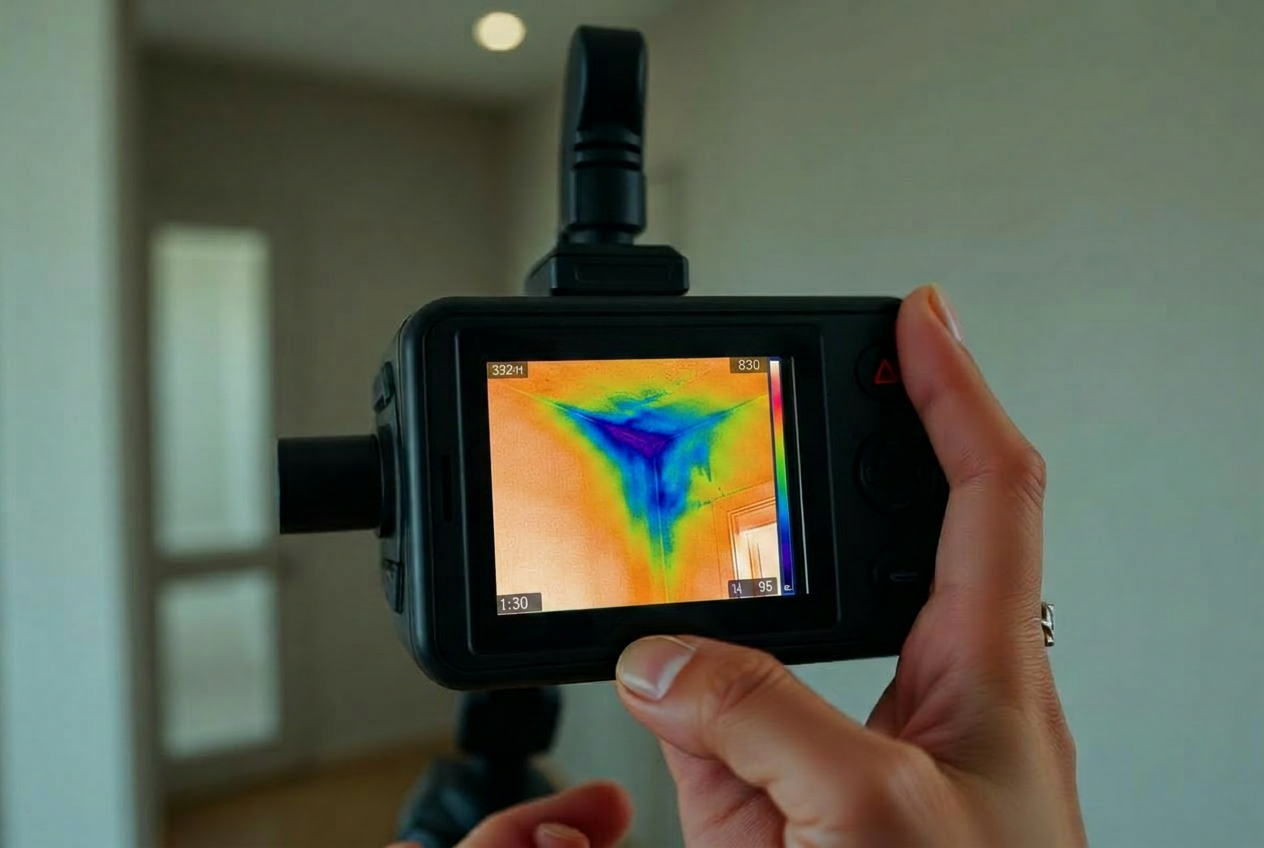
Seeing what the naked eye misses.
Thermal imaging — also called infrared imaging — is one of the most valuable tools in a modern mold inspection. A professional infrared camera detects subtle surface temperature differences invisible to the human eye. Cool spots on a ceiling, an unexplained cold strip behind a baseboard, or a temperature gradient around a window often correlate with hidden moisture, air leakage, or missing insulation — the precursors to many mold problems.
Every Wiseman Mold Inspection in San Diego includes thermal imaging of suspect areas as part of the visit. Stand-alone thermal imaging inspections are also available for clients who want a non-invasive scan of a specific area — a recently repaired roof leak, a remodeled bathroom, a slow drain near a kitchen island, or a coastal La Jolla wall that always feels cold.
How professional thermal imaging actually works
Infrared cameras measure long-wave infrared radiation emitted by every surface. The camera converts those measurements into a color-coded image, where temperature differences as small as a fraction of a degree become visible. Damp materials hold and lose heat differently than dry materials, which creates the contrast that experienced inspectors use to identify hidden moisture pathways.
Thermal imaging is not magic. It does not see through walls, it does not detect mold directly, and it can produce false positives if used in isolation. That is why we always pair a thermal scan with calibrated moisture meter readings, hygrometer data, and visual context. The combination is what makes the interpretation reliable.
Common San Diego findings
In Hillcrest, Mission Hills, and North Park homes, thermal imaging often reveals chronic shower-pan leaks, slow drain leaks at sink locations, and HVAC condensate overflow. In La Jolla, Pacific Beach, and coastal areas, it identifies window flashing failures, stucco moisture intrusion, and condensation behind exterior walls. In newer construction across Carmel Valley, Scripps Ranch, and Mira Mesa, thermal imaging detects HVAC duct sweating, water-heater pan issues, and slab penetration leaks.
When to schedule thermal imaging
Schedule a thermal imaging inspection after any water event, before closing on a home, after a recent repair you want verified, when a stain keeps returning, when an HVAC system seems to be condensing where it should not, or when you simply want a non-invasive baseline of moisture conditions throughout the property. It is also a powerful addition to a real estate inspection when the property has known prior water damage.
What you receive
A digital report including high-resolution thermal images of every area of interest, paired moisture meter readings, hygrometer data, photographs of the corresponding visible surface, and a written interpretation. Anomalies are categorized by severity and matched to recommended next steps — typically targeted repair by a qualified plumber, roofer, or HVAC technician, rather than wholesale remediation.